Image: Animals Uncovered
Securing higher welfare standards for chickens raised for meat
Every year, over 750 million chickens are raised for meat in Australia. They are bred to grow so fast that their health and welfare suffer – together, we can change this.
The Australian Alliance for Animals is raising the welfare standards for chickens farmed for meat through the Better Chicken Australia campaign.
The campaign supports the Better Chicken Commitment (BCC) – an internationally recognised policy that calls on food businesses to adopt meaningful welfare improvements across their chicken supply chain. This includes using slower-growing, higher-welfare breeds, improving living conditions, and adopting more humane slaughter methods.
Australia has recently taken an important step forward, with RSPCA Certified introducing a pathway for producers and food businesses to meet the BCC. But fast-growing breeds can still be RSPCA Certified, and most Australian chickens continue to be raised under systems that fall short of the BCC.
By building public awareness and engaging food businesses directly, we’re working to improve the lives of chickens raised for meat in Australia.
-
Like most Australians, I care about the welfare of farmed animals.
Chickens farmed for meat are one of the most poorly treated animals in the agriculture industry. Every year, millions of Aussie chickens suffer short, miserable lives before being slaughtered using outdated and cruel methods.
I want that to change.
As many Australians like me grow more aware and concerned about where our food comes from, I'm looking to restaurants and shops to match my expectations for better animal welfare, sustainability, and food quality.
I’m calling on food businesses to sign the Better Chicken Commitment and introduce higher welfare standards for all chickens in their supply chain. This includes better living conditions, more humane slaughter methods, and switching to healthier, slower growing chicken breeds that promote good welfare.
It’s time to change the way we raise chickens for meat in Australia.
The Better Chicken Commitment must be the new standard for Aussie chickens.

Image: RSPCA UK
Part of a strategic partnership
The Alliance for Animals is one of fifteen leading animal welfare organisations supporting the Australia-New Zealand Better Chicken Commitment.
We are working closely with Alliance core member World Animal Protection and our New Zealand-based colleagues at Animals Aotearoa to increase the uptake of the Better Chicken Commitment in Australia through the Better Chicken Australia campaign.
This campaign focuses on:
Building public understanding of the welfare problems facing chickens raised for meat
Mobilising consumers to create pressure for change
Securing Better Chicken Commitments from food businesses

Image: Farm Transparency Project
Why chicken welfare matters
In Australia, a staggering 750 million chickens are raised and slaughtered for meat every year. Most of these birds lead short, miserable lives.
Australia has poor welfare laws and standards for chickens – and very little has changed over the last decade, despite growing public concern and progress overseas.
One of the biggest causes of suffering is the type of chicken itself.
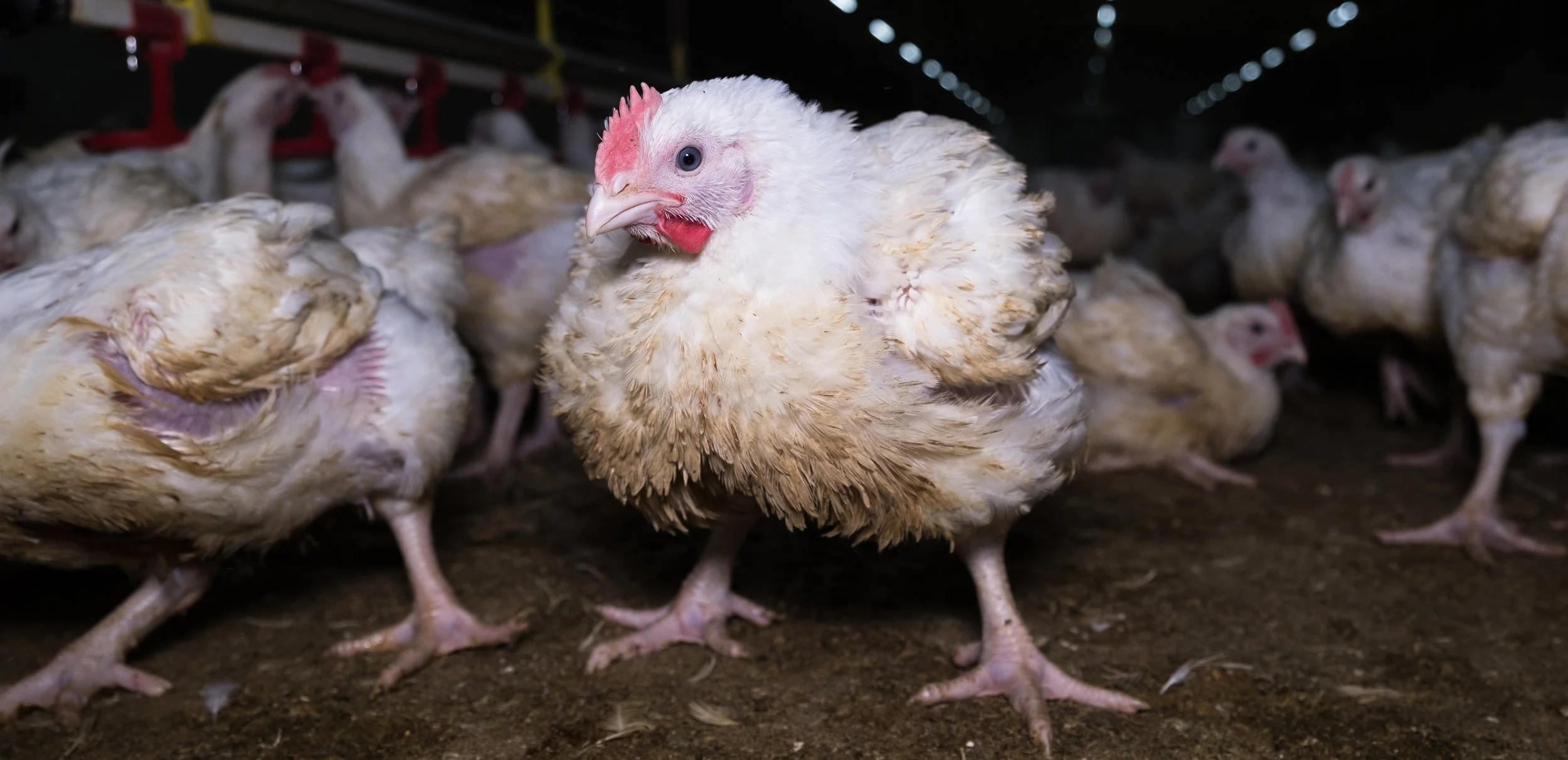
Chickens bred for meat are genetically selected to grow unnaturally large and fast, reaching slaughter weight in just five weeks. Their bodies often struggle with this growth and weight, leading to difficulty walking or standing, chronic pain, and other health issues.
Chickens also experience:
Overcrowded living conditions that restrict their ability to move freely
Little to no enrichment or opportunities to perch, scratch, dust bathe, and perform other natural behaviours
Poor air quality and often no natural light
Outdated slaughter methods that cause significant suffering.
Changing living conditions matters, but meaningful welfare improvements must also address breed.
That’s why we’re calling for the industry to make serious changes to the welfare of chickens bred for meat.
An important step forward for chickens
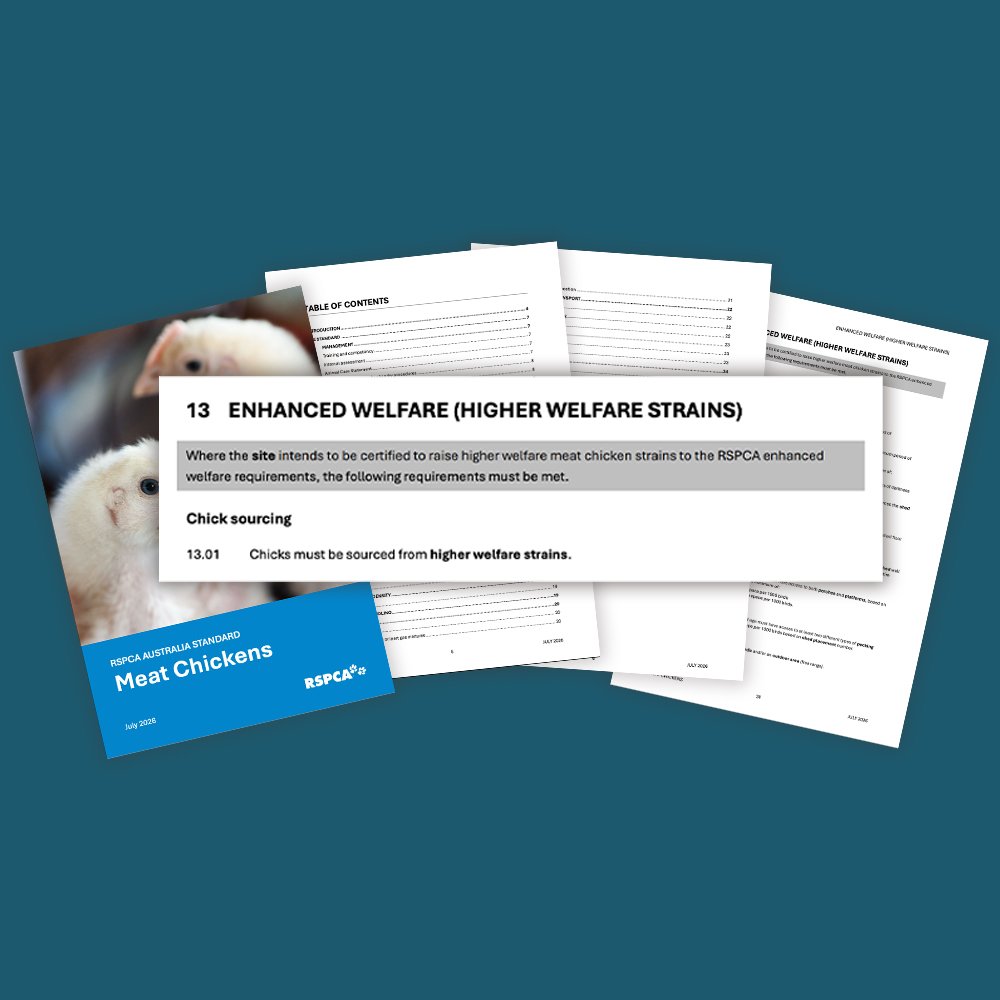
In 2026, RSPCA Australia revised its Meat Chicken Standard.
For the first time, an Australian certification scheme now includes requirements for slower-growing, higher welfare chicken breeds. The RSPCA Australia Meat Chicken Standard’s new slower-growing level contains BCC-aligned requirements, providing Australian producers and food businesses with a pathway towards the BCC.
But this is treated as an add-on – the core RSPCA Australia Standard still doesn’t meet the Better Chicken Commitment.
The 2026 Standard still allows fast-growing breeds to be certified, meaning chickens can continue to experience serious breed-related welfare problems.
This is where Better Chicken Australia plays an important role. As transitioning Australia’s chicken supply chain will take time and relies on commercial demand, food businesses need to act now by committing to the BCC and planning how they will transition their supply chains.
What is the Better Chicken Commitment?
The Better Chicken Commitment is an internationally recognised policy commitment that asks food businesses to meet a clear set of welfare requirements for chickens raised for meat.
Businesses that make the commitment agree to transition their chicken supply chains to meet requirements including:
Slower-growing, higher welfare chicken breeds that reduce chronic health and mobility problems associated with extreme growth
Improved living conditions with more space, light, and clean air
Environmental enrichment that allows chickens to express natural behaviours
More humane slaughter methods, with effective stunning and no live shackling
The Better Chicken Commitment has already been adopted by hundreds of major companies internationally. Australia now has a pathway for food businesses seeking to source BCC-compliant chicken. The next step is for more Australian companies to make the commitment and begin their transition.
You can read more on the Better Chicken Australia website.

Consumers can help drive the change chickens need
Food businesses have the power to change how millions of chickens are raised – and customers can help persuade them to act.
As public awareness of factory farming and chicken welfare grows, companies are under increasing pressure to improve the standards used throughout their supply chains.
Now that RSPCA Certified has a slower-growing level, Australian businesses have a pathway to meet the Better Chicken Commitment.
What we need now are more commitments.
Food businesses can commit today to transition their supply chains, giving producers the certainty and demand needed to make change possible.
The Better Chicken Australia campaign works to mobilise Australians who want better treatment for chickens raised for meat and encourages businesses to adopt higher welfare standards.
By writing to food businesses, consumers can help create a food system that better reflects community expectations around animal welfare.


Frequently asked questions
-
The Better Chicken Commitment is a commitment for businesses to introduce higher welfare standards for all chickens in their supply chain. It sets targets for the most important welfare issues in chickens raised for meat, based on the latest welfare science. The Better Chicken Commitment calls for:
Higher welfare, slower growing chicken breeds
Comfortable, healthy living conditions, where each chicken has enough space, light and clean air
Slaughter methods that are more humane, with effective stunning and no live shackling
You can read more about the specifics of the BCC and why these changes are so important here.
Add your name to the Better Chicken Commitment pledgeto show food businesses and the industry that there's appetite for change. This will show the industry how important these changes are.
Your voice will lead change. Find out more about taking action here.
If you're a food business interested in signing up to the Better Chicken Commitment, get in touch and we’ll help you through the process.
-
Chickens farmed for meat in Australia face many serious welfare issues. They are genetically selected to grow too big and fast for their own bodies to handle. They don’t get enough space, light, or clean air, and they are killed using outdated, inhumane methods.
Breed
The breeds of chickens used for meat in Australia been genetically selected to grow so fast it hurts.
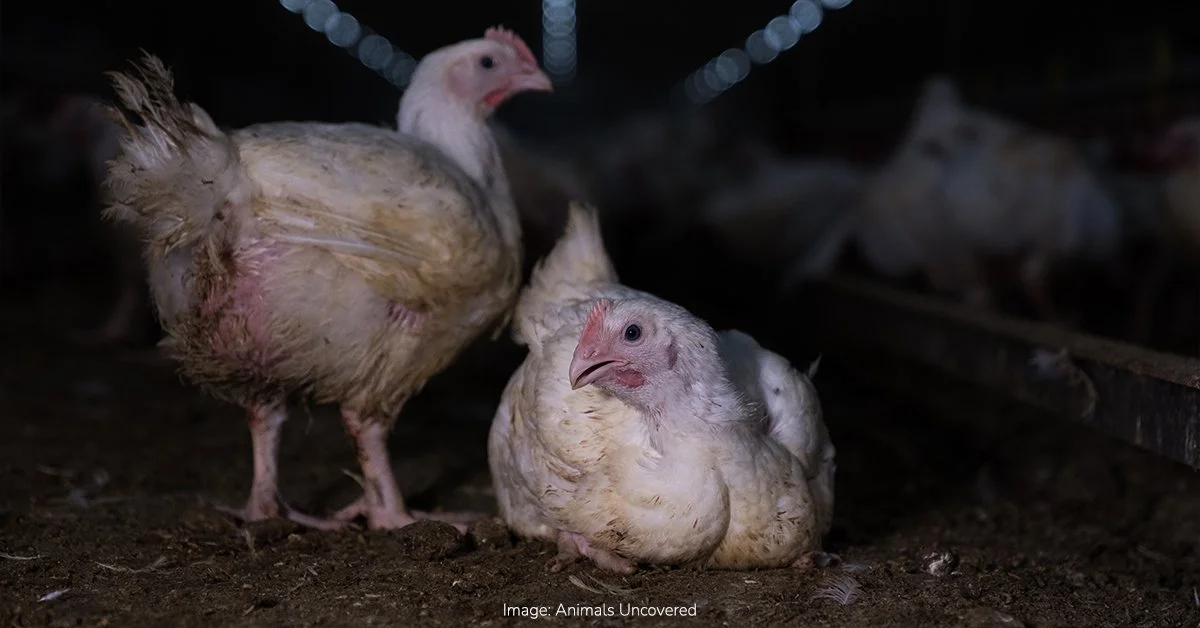
They struggle to stand and move around under their own body weight. They suffer from lameness, painful skin burns, bone deformities, metabolic diseases and high death rates.
These fast-growing chicken breeds are designed to maximise meat production and profit, at the cost of chicken welfare.
Living Conditions
Modern chicken farming involves tens of thousands of birds being packed into sheds at high densities. They may never experience natural light or clean air, have enough room to scratch around or dust bathe, and there may be nowhere to perch.
Without enough space, they can struggle to move around freely. Chickens can’t act like chickens here. When these chickens are fast-growing breeds, you have a perfect environment for creating sick, stressed, suffering birds.
Slaughter
Australian chickens routinely experience fear, pain and suffering during slaughter due to the use of outdated, inhumane methods. Many slaughterhouses still use shackling and electrical stunning, where chickens are hung upside down by their legs and dipped into an electrified water bath to be stunned before slaughter. This is stressful, painful and unreliable, leaving some chickens fully conscious when their throats are slit.
The Better Chicken Commitment includes requirements to address each of these three key aspects of chicken welfare.
-
The welfare of chickens raised for meat is a huge problem for two reasons. First, because the scale of the industry is immense, affecting hundreds of millions of birds. Secondly, because most of these chickens will live short, miserable lives.
The chicken meat industry impacts the biggest number of animals of any land-based animal industry. The Australian chicken industry raises and slaughters over 700 million chickens every year. That’s about 49kg of chicken meat eaten per person every year – way more than any other type of meat.
The scale is so enormous that it’s hard to think of chickens as the individual animals that they are. They have needs and wants, things they do for fun, and friendships with the other chickens they live with. While their lives are short when we use them for food, that doesn’t mean we need to accept them suffering.
It’s challenging to raise millions of chickens while also making sure each one of those chickens lives a happy life. Which is why the Better Chicken Commitment focuses on changing the farming practices – breed, living conditions and slaughter – that have the most negative impact on the quality of life for chickens raised for meat. Adopting the BCC requirements will make the lives of millions of chickens in the future much better.
-
The chickens used for meat are not the kind of chickens you might keep in your backyard. They’re specialised breeds created to grow as fast as possible, with as much breast muscle as possible. This is because it is more profitable to send ‘meatier’ birds to slaughter in a shorter amount of time. It's a more cost-effective way to get chicken meat, however, this comes at a severe cost to chicken welfare.
In Australia, almost every chicken raised for meat is one of these fast-growing breeds. They reach slaughter weight (the size that whole chickens are sold at, which is around 2kg)in just 38 days (5 weeks). They are also very imbalanced, with such heavy breasts that they often struggle to stand and walk. If they fall over onto their backs, they may be unable to get up to reach food or water.
Because they’re bred to grow so fast and so big, they suffer serious health issues like bone deformities and lameness. Sometimes these health issues are so severe that they die before they reach slaughter weight. The meat chicken industry can absorb this loss because the chickens that do survive grow so fast and large. If you took one of these chickens home to keep as a pet, they wouldn’t live long no matter how well you cared for them. They’re not built to survive their own body’s weight.
-
When it comes to farmed animal welfare, Australian laws are weak. You might expect Australian laws to protect chickens from pain, fear and suffering, just like laws protect pets and wildlife. That’s not the case. The Australian government lags far behind community expectation and the latest science. As a result, millions of farmed animals suffer every year.
The minimum legal standards for chickens raised for meat in Australia are set by the Model Code of Practice for the Welfare of Animals – Domestic Poultry. These standards let chickens live in crowded, stressful conditions with no ability to perform natural behaviours like perching and foraging.
A new standard, the Australian Animal Welfare Standards and Guidelines for Poultry, was endorsed by State and Territory governments in 2022. These standards are only slightly better than the previous Code, and they still don’t require farmers to provide perches for chickens or give them enough space to move around freely. What’s more, these standards haven’t yet been written into law, so they can’t even be enforced!
This is why it’s so important for food businesses to sign up to the Better Chicken Commitment. We can’t rely on government regulation to protect chickens from suffering or ensure they live lives worth living. If we want to be sure that the chicken we eat came from a bird that was happy and healthy, we need a promise we can trust. The Better Chicken Commitment provides that promise.

Image: RSPCA UK
Related resources
Explore our collection of articles and media releases about the welfare of chickens raised for meat.


Find out more about farmed chicken welfare from our core member organisations